

How to correctly install a 48V 4NO903028 alternator on Audi A6, Q5, Q7, Q8 with MHEV: detailed technical instructions
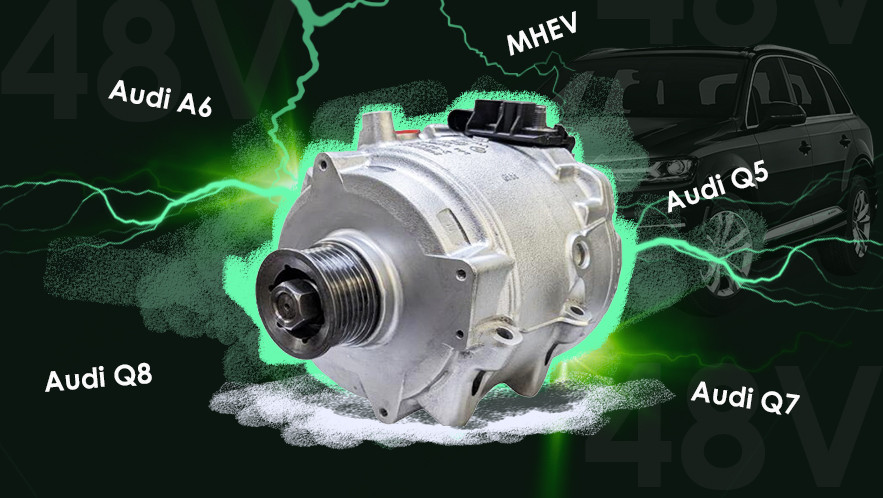
Audi's 48-volt starter generators are smart units with high thermal loads and complex integration into the car's electronics. Incorrect installation or adaptation can lead to instant failure of the unit. STS is one of the first services in Eastern Europe that professionally repairs and tests Audi 48V iBSGs and has practical experience that is not always available even to dealers today. Below is an in-depth guide for B2B customers and installers, designed to minimize risks.
What is MHEV and why is the 48V iBSG a separate class of units?
Modern Audi cars with the Mild-Hybrid Electric Vehicle (MHEV) system operate on the principle of supporting the internal combustion engine with a 48-volt electrical system. This is not a full hybrid transmission, but an intelligent energy module that:
- assists the engine during repeated starts and can start a hot engine without using the 12V starter
- regenerates energy during braking
- provides short-term electrical assistance to the engine
- optimizes fuel consumption and reduces emissions (the internal combustion engine runs less)
The main component is a 48V starter-generator (iBSG) installed on 3.0 and 4.0 engines in the Audi A6, A7, A8, Q5, Q7, and Q8 lineups (part numbers 4N1903028 and 4N0903028). Its service life directly depends on the condition of the electrical system, cooling system, and software integration accuracy.
Unlike a conventional generator, the 48V iBSG:
- functions as a starter, generator, and recuperator
- is controlled via CAN buses with a high exchange frequency
- has a separate liquid cooling circuit
- is critically sensitive to the quality of the antifreeze supply
- requires adaptation in the ECU after replacement
Because of this, the usual “remove and replace” approach does not work here, since the system consists not only of a starter-generator, but also includes a battery and a DC/DC converter, which are also involved in the charging process.
Preparation before installation: what to check before starting work
The starter-generator should only be installed by a qualified specialist. Before installation, a comprehensive check of adjacent systems and components must be carried out to ensure that they are in good working order and will not cause overloads or incorrect operating modes for the new unit. This is a key condition for its durability and correct functioning.
It is worth noting that some engines in the lineup are equipped with a separate electric pump to circulate coolant through the iBSG circuit. Jamming of this pump can also lead to a loss of circulation, which in turn can cause the iBSG to overheat.
STS recommendation: check the operation of both the main and auxiliary pumps before and after installing the starter-generator.
If these conditions are met, the system will be ready for unit installation.
Key requirements for installing a 48V iBSG generator
Three basic conditions must be met for safe start-up. Each of them has a technical justification.
1. 48V battery charge — at least 70% (≈ 49.5 V)
The MHEV lithium battery powers and starts the iBSG. If it is partially or completely discharged, the system may operate with limitations:
- The iBSG goes into reduced load mode or does not activate at all
- The electronic modules receive unstable voltage, which can lead to malfunctions
- The load on the conventional starter and 12V system increases, which increases the risk of engine start failure
In such a situation, the car usually starts like a conventional car without MHEV functions, but the efficiency of start-stop and energy recovery is reduced or completely absent.
Because of this, it is a mandatory requirement of our company (it is specified in the instructions for the unit) to photograph the condition of the battery before installing the starter-generator. Without this, we cannot provide a warranty for it.
2. Antifreeze refilling — only with a vacuum system
Air left in the water channel is the most common cause of overheating and accelerated degradation of the unit. Circulation in the iBSG is weaker than in the engine cooling system, and the thermal load is high.
This is especially critical when replacing the auxiliary electric pumps of the iBSG cooling system: they are sensitive to cavitation and have a small performance reserve. Conventional filling with air “pushing” is unacceptable.
3. Software adaptation (offline coding)
After physical installation, the system must “recognize” the new unit. Without this, the MHEV may operate in reduced mode or with errors, and the generator may not pick up the load correctly.
Suitable tools:
- ODIS (original)
- Autel
- Launch
- others with Audi MHEV support Offline coding
During adaptation, the following is performed:
- engine selection by code
- cooling configuration adjustment (additional pump / no pump)
- recording parameters in the ECU
Typical Audi iBSG error codes and their meanings
If the generator is installed incorrectly, the ECU usually records the following codes:
Code Description Probable cause
- P0C73 Overtemperature / overheating Air or low circulation in the circuit
- P0C62 Generator performance Incorrect adaptation / low 48V charge
- P0C74 Coolant pump performance Main/auxiliary pump malfunction
- U1013 / U1008 CAN communication faults Incorrect connection / programming
- P30E0 Voltage supply malfunction Low charge or battery degradation
Step-by-step installation algorithm
For convenience, here is a structured sequence:
- Disconnect the 48V circuit
- Remove the old unit; inspect the belt/rollers
- Installation of new unit and correct tightening of fasteners
- Vacuum filling with antifreeze
- Connection of 48V system and voltage control
- Diagnostics and code clearing
- Offline adaptation iBSG
- Start-up and control: temperature, pump operation, 48V charge stability, CAN errors
- Test drive 5–10 km
Professional installation is the best option
Our experience shows that even experienced technicians working with Audi MHEVs for the first time encounter nuances. This is not a conventional generator—it is part of the car's power module.
Installation at STS is the safest option for both the unit and the car. If you choose to have it installed elsewhere, these instructions will minimize the risks.
Conclusion
The Audi 48V starter generator is a high-precision unit that is sensitive to:
- the condition of the battery and electronics
- the cleanliness and completeness of the cooling circuit
- correct adaptation and parameter recording
Compliance with the protocol guarantees the service life and stability of the MHEV system.
STS provides units, service, technical support, and is one of the leaders in the repair of these systems in Eastern Europe.