



Tesla Model 3 from the U.S.: Conversion of the charging system to meet European standards and comprehensive repairs following a car accident
TESLA Model 3
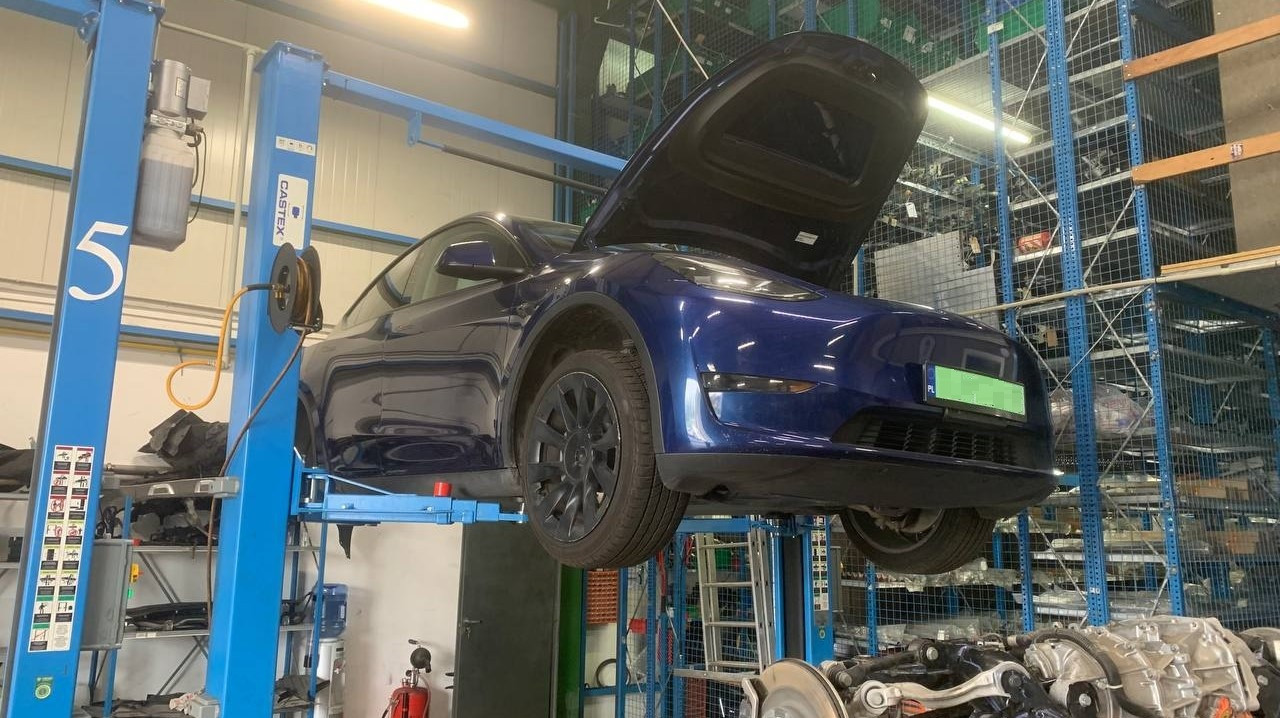
Buying a Tesla Model 3 at auctions in the U.S. is a popular way to save a significant amount of money, and it has become a real trend in many European countries, particularly in Poland. Unfortunately, after the initial excitement of winning a bid and completing body repairs, owners often face a harsh reality: due to differences between American and European charging infrastructure, the car takes hours to charge from a single-phase outlet or won’t charge at all at CCS2 fast-charging stations.
It was precisely with this set of problems that the owner of a 2020 Tesla Model 3 AWD turned to the specialists at STS.Electro in Warsaw. The car had been repaired after a severe rear-end collision, but to be fully operational, it required several critical fixes: a major conversion of the charging system to the European CCS2/Type 2, scheduled maintenance of the electric drivetrain, and—as it turned out during the repair process—restoration of the rear suspension’s geometry (and thus its safety).
Tesla USA → EU Conversion: Why Is Simply Replacing the Connector Not Enough?
Why do attempts to retrofit an American Tesla by simply mechanically replacing the connector with a Type 2 one or using cheap adapters usually result in the car charging from only one phase (at most 3.7–7.2 kW instead of 11 kW) or even block CCS Combo 2 fast-charging stations altogether? The reason is that U.S. versions of electric vehicles use a combined single-phase NACS line. The European standard requires separate lines for the three phases of alternating current (AC) and separate high-power busbars for direct current (DC).
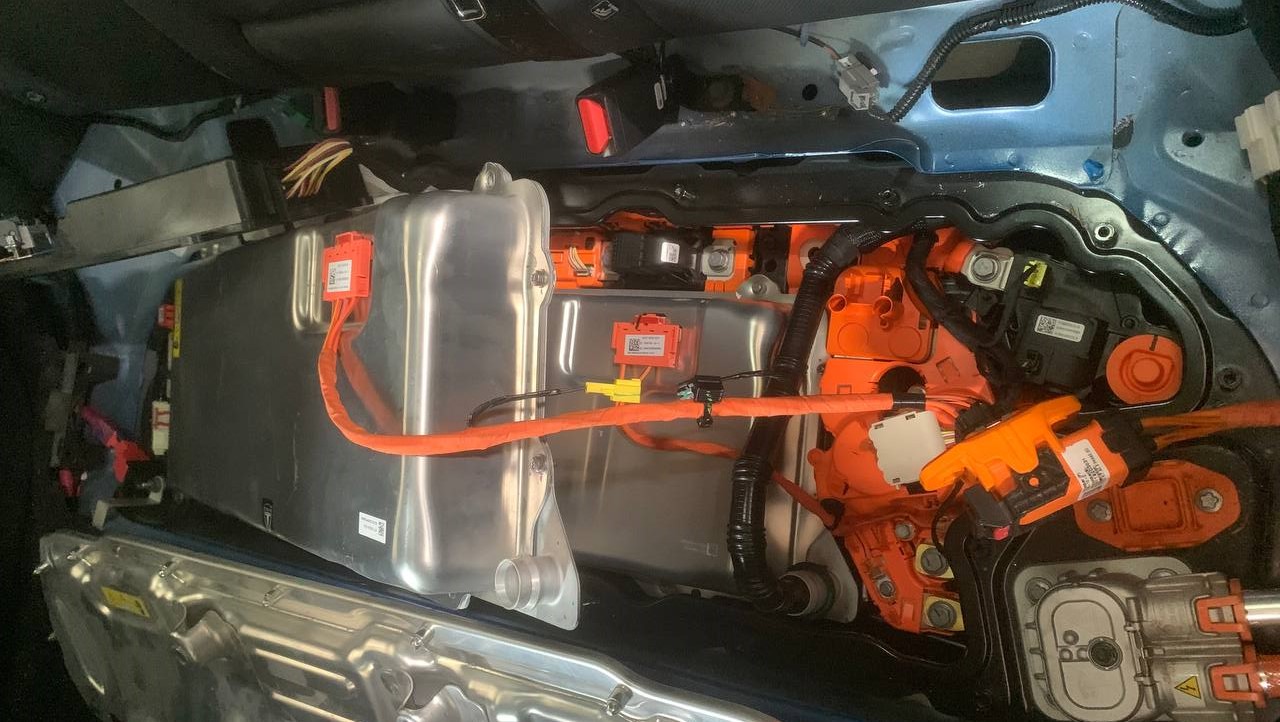
Therefore, for a full conversion, we performed a component-based upgrade without the costly replacement of the entire power conversion system (PCS) assembly:
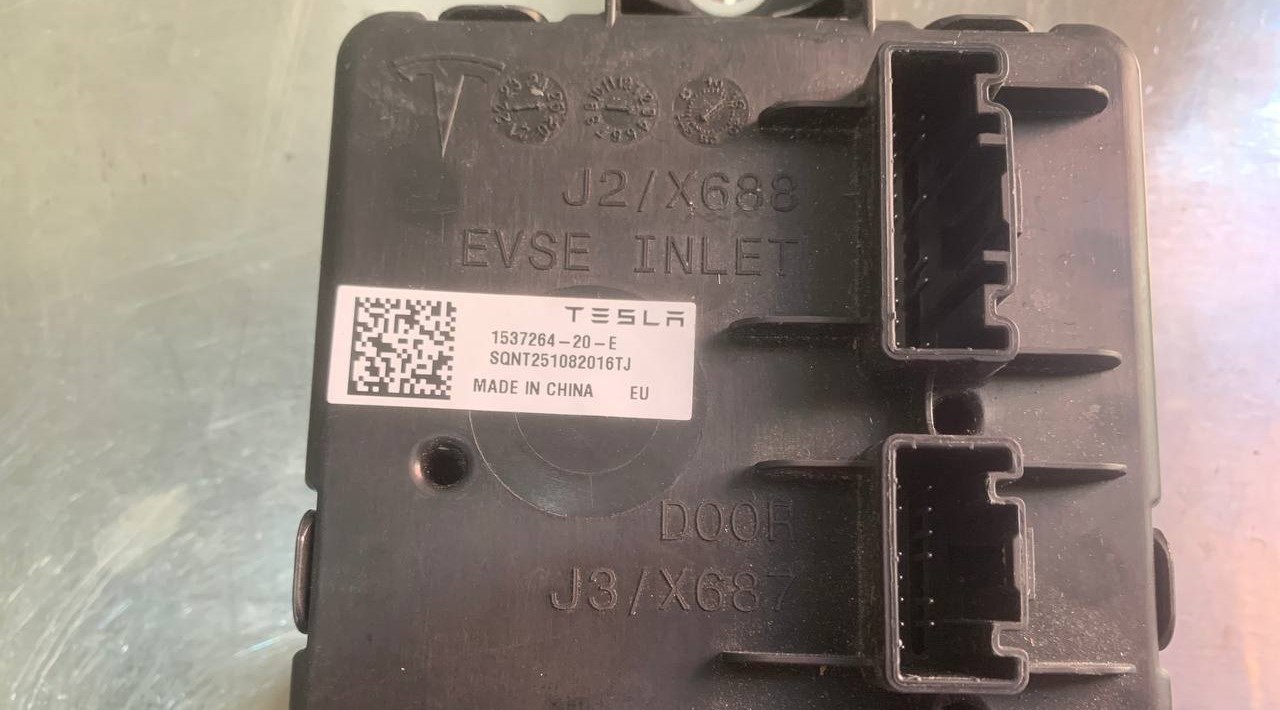
- Charge Port ECU Gen 4: We removed the American unit 1537264-10-E (NA) and installed the European module 1537264-20-E (EU) was installed to ensure proper control of the European actuator, 3-phase recognition, and support for the CCS2 protocol.
- Power Cable (3-Phase AC Cable Kit): The American 1-phase wiring 1509395-00-D from the connector to the charger with a special 3-phase high-voltage cable 1509395-10-D (CP CABLE KIT, AC 3 PHASE IEC). Without this cable, it is physically impossible to supply three phases of alternating current to the power unit.
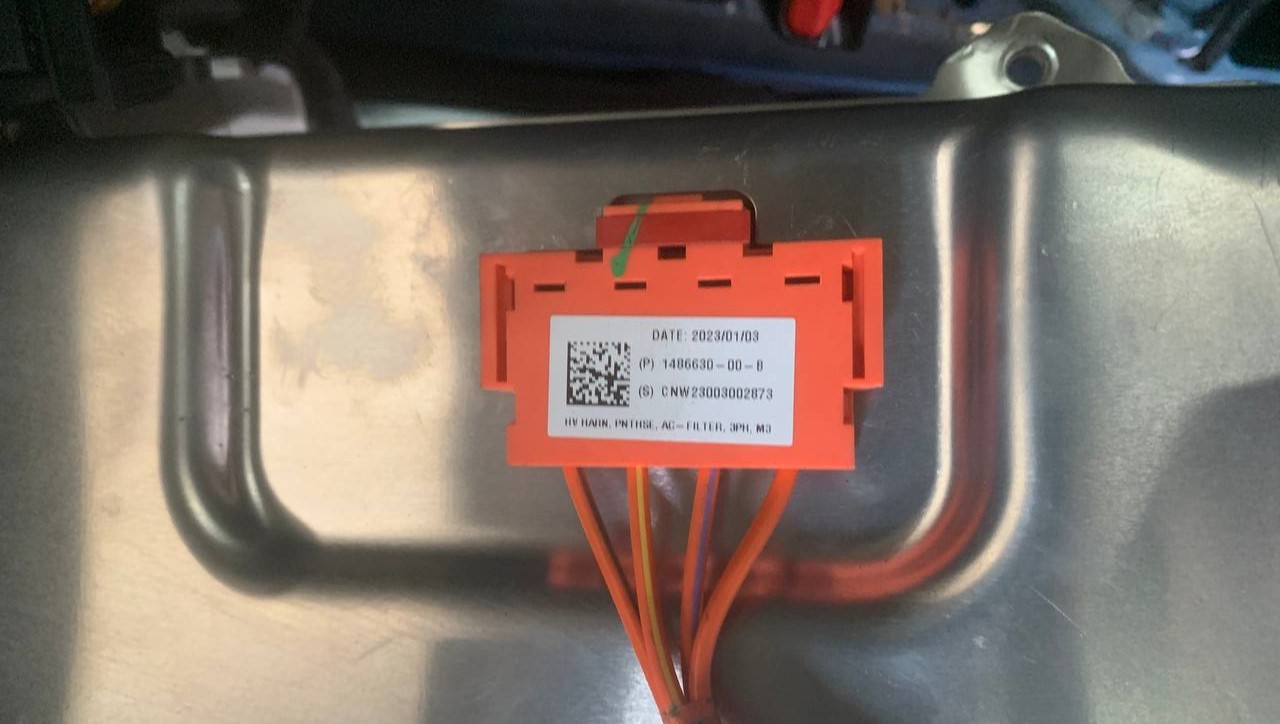
- Power Conversion System (PCS / On-Board Charger) Upgrade: Instead of purchasing a new complete charging module, the technicians disassembled the PCS housing (1135558-05-A) and replaced the internal American 1-phase high-voltage filter 1092789-00-E with a European 3-phase 1486630-00-B.
- Charging port and wiring: A European Type 2 / CCS2 port with the corresponding signal bus was installed.
Specifications of Replaced Components (USA → EU)
| Component | Original U.S. part | European part / Modification | Purpose and Result |
| Port electronic module | 1537264-10-E (Gen 4 NA) | 1537264-20-E (Gen 4 EU) | Controls European actuator/doors, CCS2 recognition, CAN bus communication |
| AC Power Cable | 1509395-00-D (1-Phase NACS) | 1509395-10-D (CP Cable Kit, AC 3-Phase IEC) | Transmission of 3-phase AC from Type 2 port to PCS unit |
| PCS high-voltage filter | 1092789-00-E (1-Phase EMI) | 1486630-00-B (3-Phase EMI HV HARN, PNTRSE, AC-FILTER, 3PH) | Distribution and filtering of the 3-phase power supply within the charging module (provides 11 kW AC) |
| Charging Port | NACS (Tesla US Proprietary) | Type 2 / CCS Combo 2 | Fully compatible with any charging stations in Poland and the EU |
Rear-end repair: identification of issues resulting from substandard repairs and replacement of the subframe
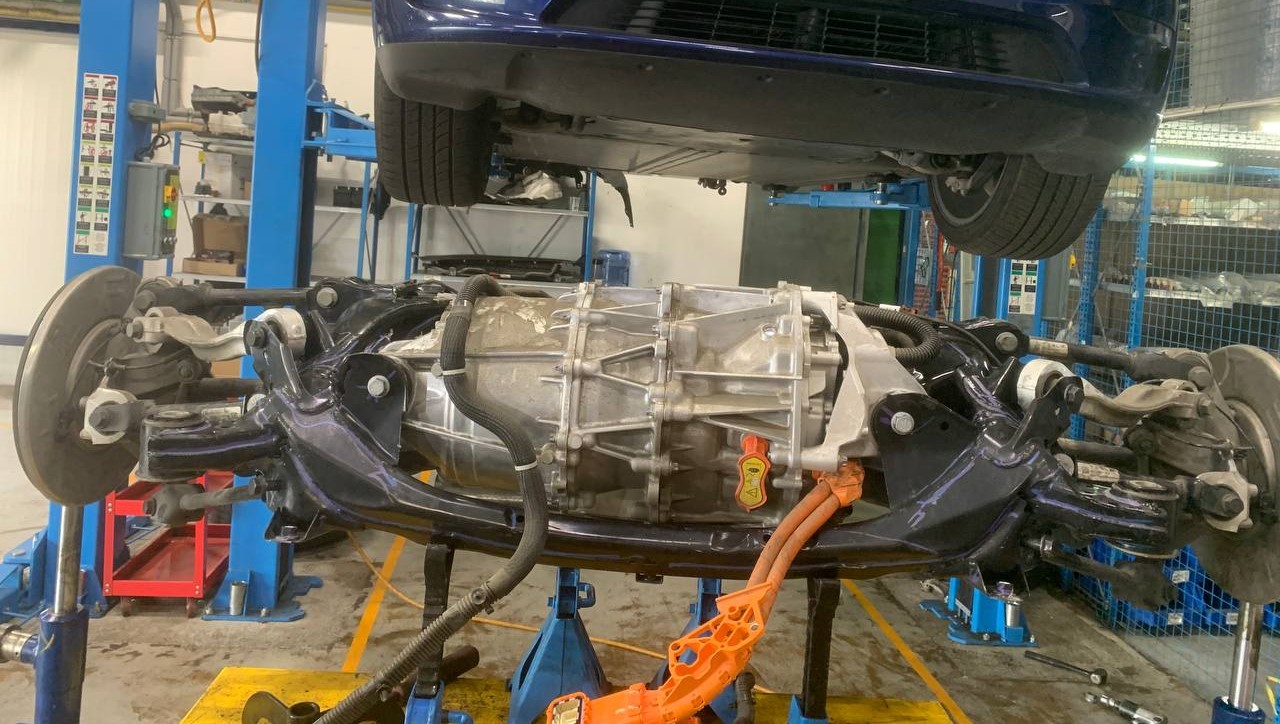
To ensure full access to internal components and wiring, our technicians removed the rear electric drive unit (RDU). However, after removing the motor, a hidden and dangerous problem was revealed: the rear subframe showed significant deformation from a severe impact during a car accident in the U.S., as well as signs of improper straightening or alignment.
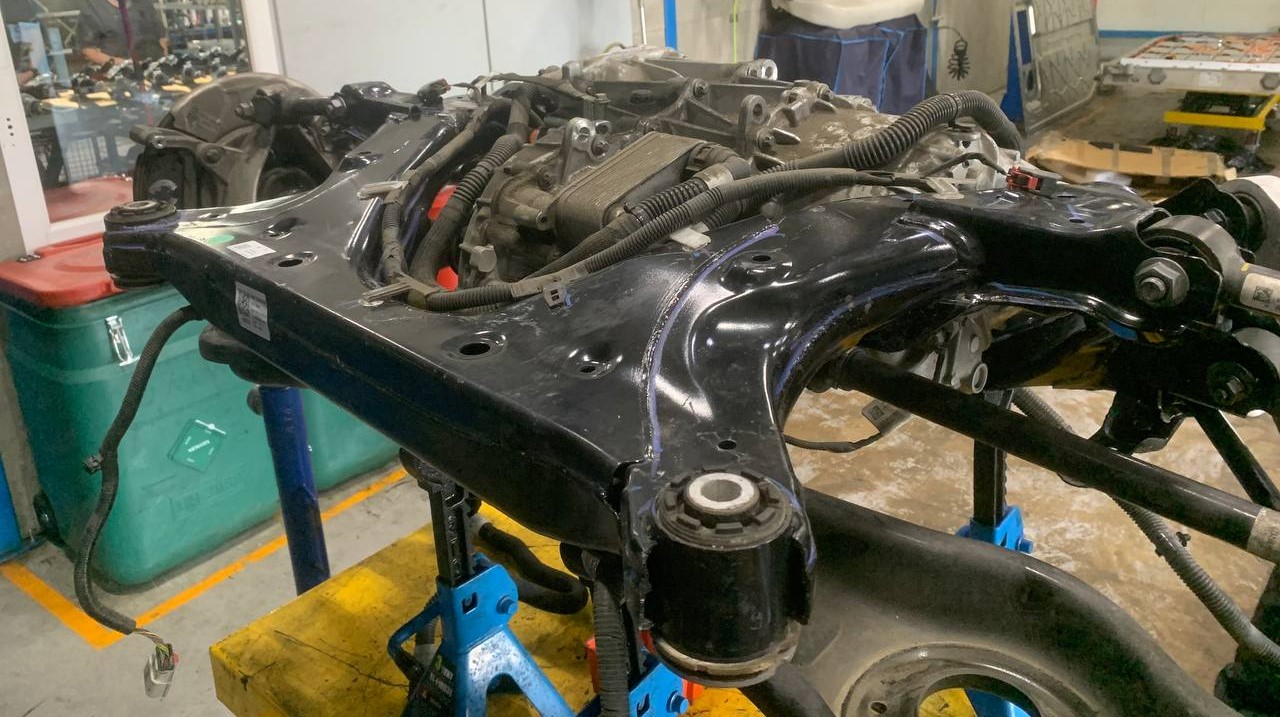
Leaving a poorly repaired suspension component on a powerful all-wheel-drive electric vehicle with instant high torque is unacceptable. The distorted subframe geometry makes it impossible to precisely adjust the toe-in and toe-out, leads to rapid tire wear, impairs handling, and poses a direct safety hazard at high speeds.
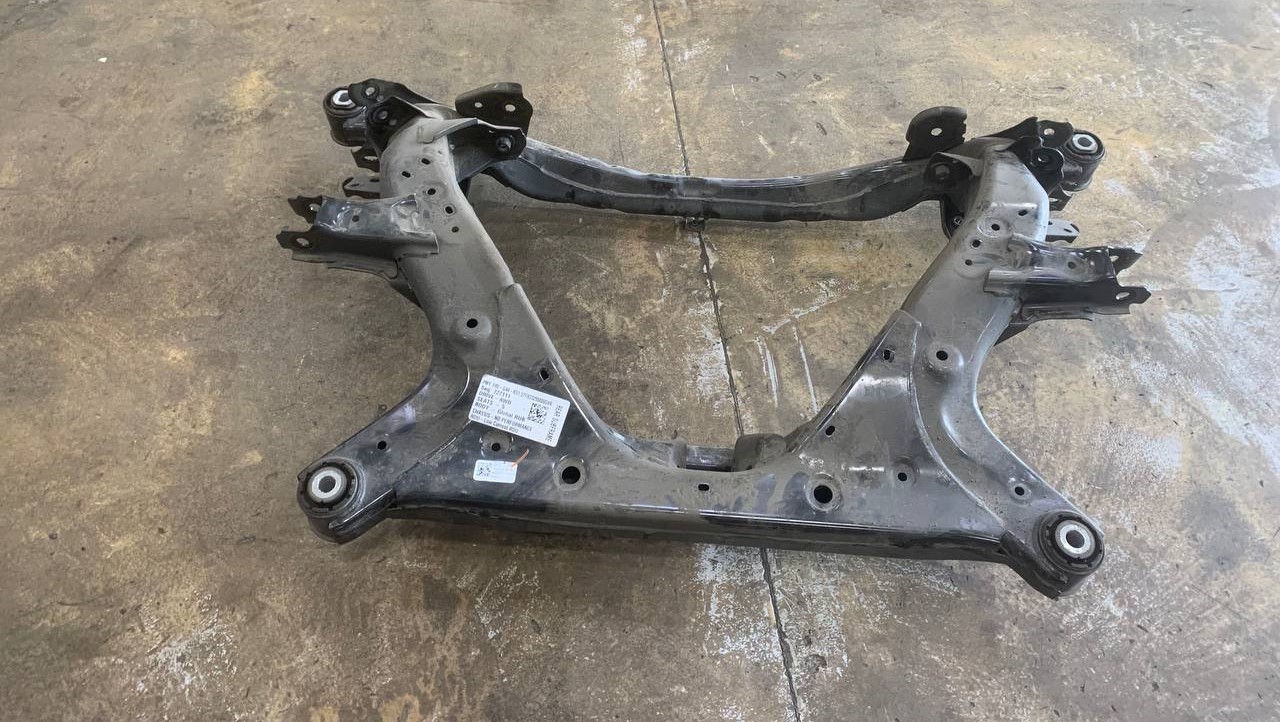
The only correct decision was made: to completely remove the damaged subframe and replace it with a new, original, one-piece subframe.
Markings on the removed/installed subframe:
- OEM number (Dyna-Mig): 1044580-00-D (Model 7 RSF)
- Body configuration: PMY-FRE-GA4-RS1 / AWD / Global RUB / Low Current RDU
A technical detail noted by STS.Electro specialists: The Tesla Model 3 and Model Y platforms share a high degree of standardization and similarity in many powertrain components. However, despite the shared platform solutions between these models, their subframes have significant differences depending on the model year, drive type (RWD/AWD), and motor version (Low Current RDU / Performance). Our specialists select parts strictly according to OEM part numbers and catalog specifications, which guarantees 100% compliance with factory tolerances.
Additional Service: RDU Preventive Maintenance
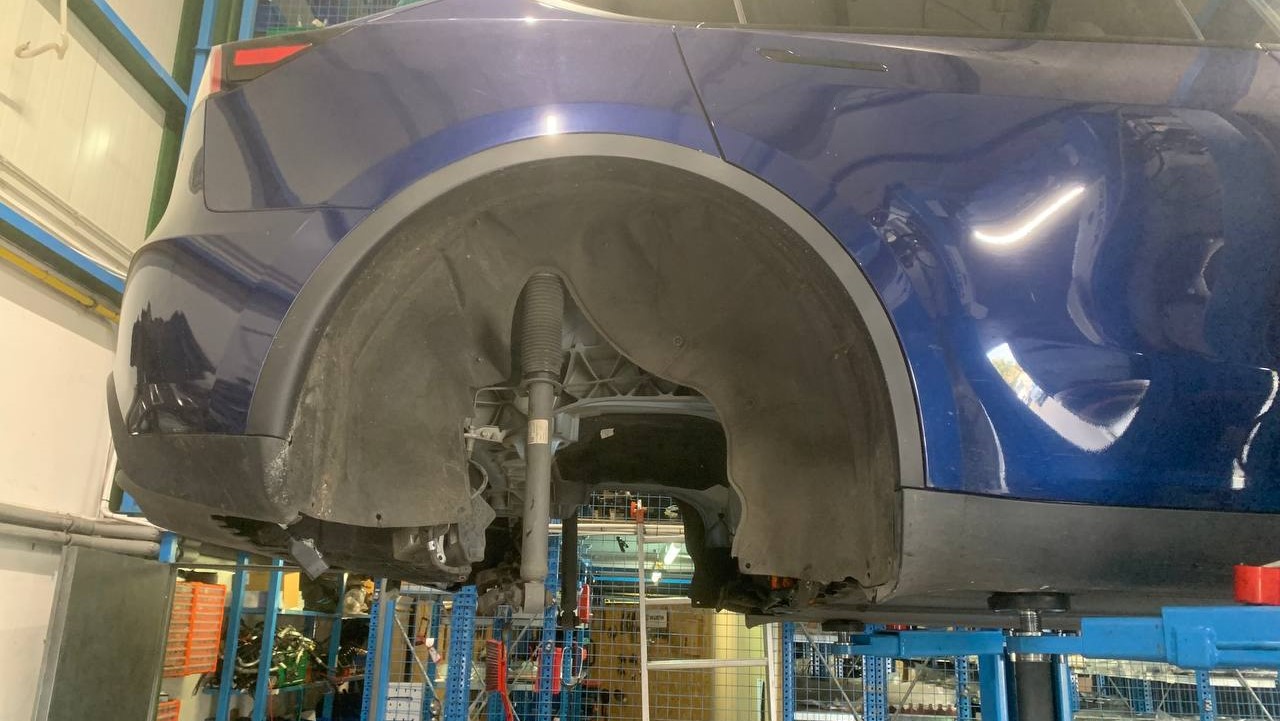
Since the rear suspension and subframe had been completely disassembled, the customer was offered additional service for the rear drive unit (RDU).
- Work Performed: Replacement of transmission fluid/oil in the rear axle differential.
- Benefit for the customer: Significant savings on labor. Changing the differential fluid on a fully assembled vehicle requires separately removing the protective covers and suspension components. Performing this procedure during the subframe replacement minimized the customer’s associated labor costs.
Comprehensive Tesla Service in Warsaw - STS.Electro
After the mechanical and electronic work was completed, the Tesla Model 3 underwent software calibration and testing at AC (11 kW) and DC (CCS2 Fast Charge) charging stations. The charging system operates in standard European mode without errors or overheating, and the suspension geometry meets factory specifications.
STS.Electro provides a full range of electric vehicle services in Poland:
- Deep conversion and adaptation of Tesla USA vehicles to European standards (CCS2, Type 2, 3-phase);
- Comprehensive defect detection and repair of damage resulting from complex accidents or substandard repairs;
- Replacement of subframes, control arms, and suspension components with precise adherence to geometry;
- Maintenance of electric drives (RDU/FDU), high-voltage batteries (HV), and thermal management systems.
Did you buy a Tesla from the U.S. or need professional repairs in Warsaw?
Don’t risk your safety and comfort by entrusting your high-voltage equipment to random repair shops. At STS.Electro, you get more than just a parts replacement—you get a comprehensive engineering approach: from the precise selection of original parts based on OEM catalogs to software adaptation and a warranty on all work performed. Need a Tesla adaptation or repair in Warsaw? Contact us for accurate diagnostics and high-quality service.