

Error P0299: What does it mean, and how do you repair a turbocharger?
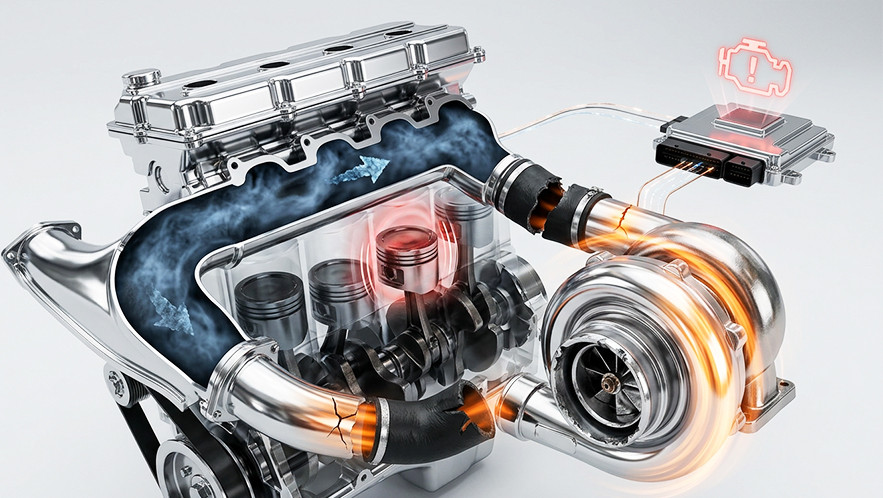
A severe lack of oxygen in the cylinders is the main reason why a turbocharged engine suddenly loses power and the on-board computer registers code P0299. This signal indicates chronic under-boost, where the stock turbocharger is unable to generate the necessary pressure due to mechanical wear or leaks in the system. Upon receiving information about the air deficiency, the control unit immediately limits engine speed for safety reasons, as continuing to drive with this malfunction can lead to problems requiring a complete overhaul of the entire unit.
The difference between P0299 and other turbocharger errors (P0234, P003A)
Owners often confuse the low-pressure code with other similar errors, despite their opposite nature. However, the electronics of a modern car clearly distinguish between the types of turbocharger system malfunctions:
| OBD-II error code | What does it mean? | Main cause |
| P0299 | Underboost | Air leak, geometry stuck in the open position, cartridge wear. |
| P0234 | Engine overboost | Geometry stuck in closed position, faulty N75 or Westgate valve. |
| P003A | Actuator learning limit exceeded | Faulty settings or mechanical wear of the electronic actuator (servo). |
Top 5 Causes of Error Code P0299
An error rarely occurs without a cause. It is usually caused by the following defects:
- Loss of system integrity: Cracked rubber or silicone boost hoses, loose clamps, or an intercooler punctured by a rock.
- Control failure: A faulty pressure control solenoid valve (e.g., N75) or a damaged vacuum line.
- Turbine mechanics: Wear or jamming of the variable geometry turbine (VNT) mechanism due to carbon buildup.
- Electrical system: Malfunction of the boost pressure sensor (MAP sensor), which sends incorrect data to the ECU.
- Related systems: Clogged diesel particulate filter (DPF) or a malfunctioning EGR system, creating excessive exhaust backpressure.
In which car models does error code P0299 occur most frequently?
In general, this can happen with any turbocharged car. But according to statistics from European auto repair shops, we have a specific group of "leaders":
- Error code P0299 is very frequently recorded on Opels (especially on 1.4 Turbo gasoline engines in the Astra and Insignia models, where the hot section of the snail near the wastegate cracks).
- This problem is no less common among VAG vehicles. Commercial vehicle owners know how often P0299 occurs in the VW Crafter, where the boost hoses and intercooler suffer due to high loads.
- In passenger cars with the legendary VW 1.9 TDI diesel engine, P0299 usually indicates that the moving vanes of the geometry are seizing up, while in newer versions of the VW 2.0 TDI, P0299 is often caused by a rupture in the vacuum actuator diaphragm.
- Sometimes a strange combination of “PKP IC error code 299” appears in search queries, but all genuine technical discussions of the issue always lead to forums for owners of VW, Ford, or Peugeot vehicles with P0299.
Recognizing symptoms before connecting the diagnostic tool
An experienced driver may suspect a turbocharger system malfunction even before connecting a scanner, based on the following signs:
- The engine suddenly goes into limp mode (no higher than 2500–3000 RPM).
- The Check Engine light or the "spiral" icon (on diesels) comes on.
- The car stops accelerating dynamically, especially when passing or driving uphill.
- Unusual whistling or hissing sounds from under the hood under load.
- Increased fuel consumption.
However, only timely diagnosis and repair of turbochargers at a professional workshop—such as STS—can fully resolve the issue.
Professional P0299 diagnostics—what does a mechanic do, and what can you do yourself?
To avoid haphazardly replacing everything in sight, it’s best to divide the inspection process into two stages: an initial self-inspection and professional diagnostic tests.
| What can the owner check? | What does a service technician do? |
| Visual inspection of hoses for cracks and oil stains. | Pressurizing the turbocharger system with a smoke generator. |
| Checking the reliability of the MAP sensor’s electrical connectors. | Computer diagnostics, reading boost parameters under load. |
| Checking the integrity of the thin vacuum tubes. | Check the vacuum level created by the vacuum pump using a vacuum gauge. |
| Cleaning out dirt if the throttle valve is stuck. | Removal and testing of the actuator on a test bench. |
Methods for repairing error P0299
Resolving the issue depends directly on the diagnostic results. If shaft play, impeller damage, or critical wear of the housing is detected, the best solution is to completely replace the turbocharger with a remanufactured or new original unit. Technicians also perform ultrasonic cleaning of the geometry to remove soot deposits, replace diaphragm or electronic actuators, and restore the intercooler’s seal.
Real-world examples of P0299 repairs in popular models
VW/Audi 2.0 TDI
The owner of an Audi Q5 came to the service center with a chronic limp-mode engagement during acceleration. Diagnostics revealed a lack of air. A smoke test showed complete airtightness, but a vacuum check revealed that the geometry actuator rod was not moving due to a rupture in the internal membrane of the vacuum element. After replacing the actuator and calibrating it, the nominal pressure returned to normal.
Ford 2.0 TDCi
The owner of a Ford Mondeo complained of a loud whistling noise under the hood and sluggish acceleration. The computer displayed code P0299. A 4 cm longitudinal crack was found on the lower intercooler hose. This was causing air to leak out. Replacing the hose with a new reinforced one resolved the issue.
Opel Insignia 1.6 CDTI
Low boost error. The problem turned out to be a jammed variable geometry mechanism due to a large amount of carbon buildup (a result of city driving at low RPMs). It was necessary to remove the turbocharger, completely disassemble it, and clean it in an ultrasonic bath.