

Audi A4 B5 steering rack - symptoms of damage
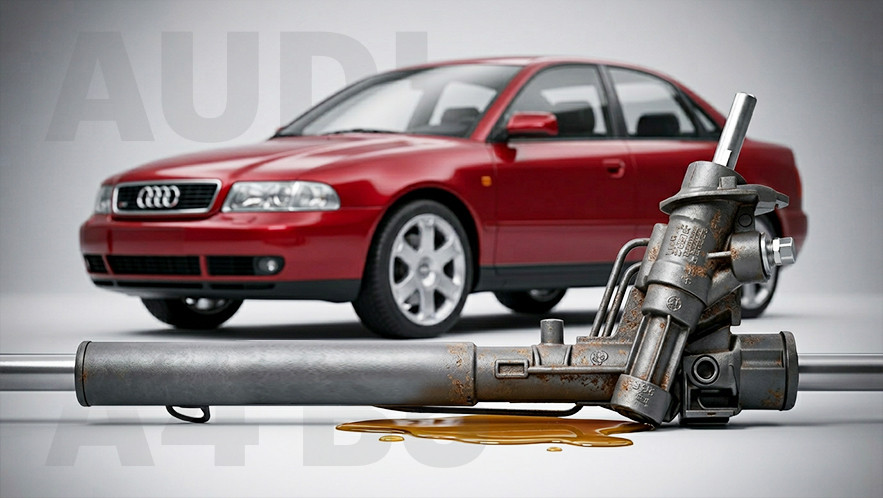
The Audi A4 B5 is a legendary car model that revolutionized the design and comfort of midsize sedans in its day. However, this car has a complex steering system, the condition of which depends directly on the suspension configuration and the type of powertrain. Due to the specific location of the component on the engine compartment, the Audi A4 B5 steering rack exhibits signs of malfunction systematically, requiring the owner to have knowledge of specific technical parts and compatibility features.
Symptoms of a malfunctioning Audi A4 B5 steering rack
Because the power-assisted steering rack is located quite high on the engine compartment in all versions of this model, it is exposed to high temperatures from the engine. This causes the rubber components to lose their elasticity more quickly. Let’s look at the main warning signs indicating that the system requires attention:
- Unusual noises while driving: Most often, this is a dull thud that occurs when driving over small bumps or during sharp turns of the steering wheel while stationary. It may indicate significant wear on the gear pair or failure of the support bushings.
- Visible fluid leaks: Oily spots under the car after parking may primarily indicate worn seals, which are included in a standard steering rack repair kit. Therefore, it is worth regularly checking the fluid level in the power steering reservoir.
- Changes in steering effort: the steering feels "heavy," with significant resistance during low-speed maneuvers. This often occurs due to internal fluid leakage within the rack itself.
- Power steering noise: a whining or humming sound when turning the steering wheel means that the power steering pump is operating in a starved condition or that air has entered the system (foam in the reservoir).
- Corrosion: This is caused by water entering the mechanism through cracks in the dust boots. This triggers corrosion of the main shaft. Rust acts as an abrasive, instantly destroying the seals.
Step-by-step diagnosis: how to check the condition of the unit yourself
Before buying auto parts, it’s worth performing an initial check. This will help determine whether the problem lies specifically with the rack, the pump, or the high-pressure hoses.
- Checking the fluid condition: Open the hood and locate the power steering reservoir. The fluid should be clear, typically green in color (according to VAG specifications). If it is black, smells burnt, or contains metal shavings or other contaminants, the system is severely worn.
- Inspecting the dust boots: A very important point for the Audi A4 B5. Any crack in the rubber boot, which protects the power steering rack shaft, is essentially an open gateway for dirt.
- Test with the engine running: Ask an assistant to turn the steering wheel while you listen for sounds under the hood. Sudden pressure surges in the hoses or metallic noises will help pinpoint the location of the problem.
- Checking for play: Try wiggling the steering tie rods by hand (with the engine turned off). If you feel significant play in the shaft itself inside the housing, the rack needs to be replaced.
Diagnostic table: symptom, cause, repair
| Symptom | Possible cause | Recommended repair |
| The steering wheel is hard to turn "when cold" | Wear on the distributor's Teflon rings | Complete overhaul using a repair kit |
| Knocking sensation in the handlebars | Wear on the center gear or bushings | Shaft grinding, bushing replacement, adjustment |
| Fluid leak from under the dust covers | Severe shaft corrosion due to water ingress | Shaft repair on a bench or replacement |
| Steering wheel sticking in certain positions | Shaft deformation or bearing failure | Immediate replacement of the assembly; driving prohibited |
| Servotronic not working (steering wheel always light/heavy) | Electrical malfunction of the valve or unit | Diagnose the electrical system and replace the valve |
Variations and compatibility: how to avoid mistakes when choosing a rack
The Audi A4 B5 steering system has several variants, so selecting a unit based on the principle of "from any B5" often leads to technical errors. The compatibility of the unit critically depends on the drive type (front-wheel drive/Quattro), engine displacement, vehicle model year, and model specification (A4/S4). If the damage is critical, instead of a repair, a completely new power steering rack assembly is purchased.
Component Manufacturers
- ZF (Zahnradfabrik): The best option. Aluminum housing, excellent serviceability. The most complete repair kits are available for these.
- Koyo: More commonly found on early models. They have a steel shaft housing that is highly susceptible to water damage. If the dust boot tears, the shaft rusts instantly.
- TRW: Installed as an alternative to ZF. Durable racks, but they have their own unique parts that are not compatible with other brands.
Factors affecting compatibility
You can’t always just take any rack from a B5 and install it on your car. You need to consider:
- Engine: On models with V6 engines (2.4, 2.8), the underhood space is limited. The tubes on the rack have a completely different shape to clear the engine. A rack from a 4-cylinder engine (R4) simply won’t fit there.
- Drivetrain: Quattro versions sometimes had different hydraulic settings.
- Gear ratios: The standard A4 has a ratio of 17:1, while the sporty S4 has 16:1. This means the steering on the S4 is “shorter” and sharper. However, in most cases, the “sport” rack fits standard cars, albeit with a few modifications.
- Servotronic: If your rack has a connector for a sensor/valve, this is a system that adjusts steering effort based on speed. A standard rack will fit in its place, but steering comfort will be reduced.
Repair options: refurbishment, replacement, or used?
Once the failure is confirmed, the owner faces a difficult choice. Each option has its pros and cons, especially considering the model’s age.
| Strategy | Advantages | Risks and Disadvantages |
| Refurbishment (Regeneration) | You receive an original part that is just as good as new in terms of service life. A professional diagnostic system is used. | Time is required for disassembly and the technician’s work (usually 1 day). |
| New Replacement | Allows you to get your car back on the road quickly. You receive a brand-new product. | Inexpensive Chinese equivalents often have a short service life and poorer steering precision. |
| Used part (from a dismantled vehicle) | Lowest price. Ideal for a quick sale or a limited budget. | It’s always a “pig in a poke.” An old rack may start leaking just a week after installation. |
Given the age and mileage of these vehicles, it’s safe to say that a professionally restored original part is almost always better than a cheap new alternative. Of course, this is true only if high-quality parts and power steering rack repair kits are used.
Can I replace the steering rack myself?
Replacing the steering rack on an Audi A4 B5 is not a task for beginners. Unlike many other cars, the rack is located in a niche between the engine and the passenger compartment. To access it, you often have to remove the battery, part of the intake system, or even slightly lower the subframe in certain models. During mechanical work, it is also recommended to check the condition of suspension elements such as the steering rack silent blocks.
Main difficulties of a DIY replacement:
- Difficult access: The mounting bolts are located in an extremely awkward spot.
- Hydraulic connections: Unscrewing the old high-pressure hoses without damaging the threads is a real art.
- Bleeding the system: After replacement, it is important to bleed the air properly; otherwise, the new unit or pump may fail due to cavitation.
Therefore, if you don’t have professional tools and a lift—and, most importantly, the necessary experience—it’s better to hire specialists for steering rack repair services. They will not only properly select, diagnose, and replace the unit but also test how the rack performs under load on a test bench. If necessary, the mechanics will replace a worn steering tie rod end or a torn protective steering rack dust boot.
Conclusion
Timely attention to symptoms is the only way to avoid costly repairs. If you don’t ignore the first signs of a malfunction, your Audi A4 B5 will reward you with perfect handling. Choose reliable parts, don’t forget about regular diagnostics, and for repairs, turn to the professionals—at the STS auto shop!