

Code P0400: What It Means and How to Repair the EGR Valve
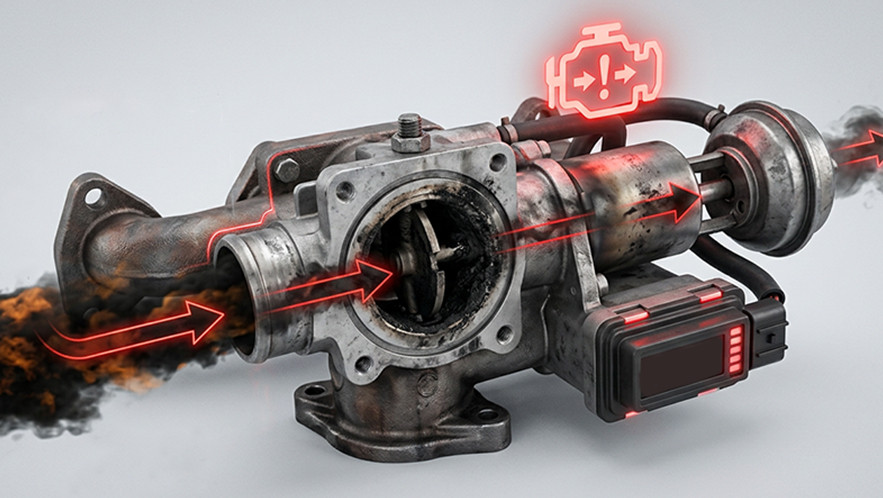
The appearance of the Check Engine light on the dashboard is always a cause for concern for drivers. In cars with modern diesel or gasoline engines, one of the most common causes of this is an error with diagnostic code P0400. This directly indicates a malfunction in the exhaust gas recirculation (EGR) system and requires a timely response to avoid more serious engine damage.
What does error code P0400 mean, and how does it affect engine performance?
In simple terms, error P0400 means that the control unit has detected an incorrect volume of exhaust gases being recirculated back into the cylinders. The main function of the EGR valve is to direct a controlled portion of the exhaust into the intake to lower the fuel combustion temperature and reduce the toxicity of emissions.
Due to an incorrect fuel-to-air ratio, the ECU switches to a protective mode, which immediately affects the car’s performance. Typically, the driver experiences the following consequences:
- Loss of power: The car begins to respond sluggishly to the accelerator pedal, especially at low RPMs.
- Unstable operation: Noticeable jerks occur during acceleration and fluctuations in idle speed.
- Switch to emergency mode: The electronics limit engine power to prevent damage to other components.
- Intake contamination: A blocked or malfunctioning EGR valve causes soot and carbon deposits to build up inside the engine at an alarming rate.
The most common symptoms of EGR malfunction and error code P0400
Failures of this kind rarely go unnoticed by the driver. Before the code is finally stored in the ECU’s memory, the owner may notice the following signs:
- The "Check Engine" light or the car-and-wrench icon regularly illuminates on the dashboard.
- Fuel consumption increases noticeably.
- Thick, dark smoke comes out of the exhaust pipe.
- A characteristic "stuttering" or engine stalling occurs when attempting to pull away smoothly.
- Difficulty starting the engine, especially in the morning when the air is cold and damp.
Main causes of the malfunction
Why does the gas flow get blocked? The most common culprit is the EGR valve itself, which, during operation, becomes coated with a thick layer of deposits and simply gets stuck in the open or closed position. However, the problem may run deeper.
Often, the solenoid valve that controls the vacuum system fails, or the vacuum hoses crack. In this case, a mechanically sound part simply does not receive the command to open. Additionally, a thick layer of soot can clog the intake manifold itself, significantly reducing the gas flow through the opening.
Opel Specifics: Error P0400 in 2.0 DTI and 2.2 DTI Engines
Owners of German Opel cars with 2.0 DTI and 2.2 DTI diesel engines (Astra, Vectra, Zafira) know this problem better than anyone else. For them, the combination of P0400 and Opel is a classic headache. Very often, the fault lies not in a purely mechanical part, but in the complex control system based on the PSG16 fuel pump. The following table shows typical scenarios for the DTC P0400 Opel error:
| Component to check | Specific symptom for Opel | Solution |
| Vacuum lines | Cracks at bends, loss of tightness | Replace damaged tubes with new ones |
| Solenoid valve | No response to ECU commands | Clean contacts or replace part |
| Intake manifold | Complete clogging of channels with fuel oil and soot | Disassembly and thorough mechanical cleaning |
| EGR valve (mechanical/electronic) | Stuck in one position | Component replacement or restoration at a service center |
Step-by-step diagnosis of error code P0400
Before buying a new, expensive assembly, it’s worth performing a thorough diagnosis. An experienced mechanic usually follows this procedure:
- Reading error codes: The computer is connected to the OBD port to analyze stored parameters and check the airflow recorded by the sensor.
- Visual inspection: Checking whether any plastic tubes or rubber hoses are damaged and whether the system maintains a stable vacuum.
- Actuator test: Using diagnostic software, the valve is forced open and closed to check its response.
- Component condition assessment: The assembly is removed to assess the level of contamination and the integrity of the membrane. You can learn more about this in the article on testing the EGR valve’s functionality.
How to effectively fix error code P0400?
If the inspection confirms that the unit is clogged with dirt, you can try cleaning it. However, as practice shows, cleaning provides only a temporary fix, and buying a new valve is an expensive undertaking.
That is why most car owners choose the most effective solution—complete software and physical removal of the system. If you’re tired of constant malfunction modes, the best solution is to order a professional deactivation of the EGR valve.
This procedure is performed in two stages. First, technicians mechanically remove the EGR valve and install a plug to ensure that exhaust gases never contaminate the intake manifold again. After that, the ECU firmware is adjusted using diagnostic software. This is necessary so that the computer does not search for the system and the P0400 error never appears on the dashboard again.
A professional EGR deactivation at STS will permanently restore the engine’s full power, reduce fuel consumption, and eliminate the hassle of constant repairs.