

Types of hybrid - MHEV vs PHEV vs HEV
Ten to fifteen years ago, the automotive market seemed relatively stable: there were cars with internal combustion engines, the first experiments with hybrids were underway, and mass electrification was something only futurists talked about. At that time, hybrids were perceived as exotic or expensive toys for enthusiasts. Today, the situation has changed dramatically: electrification has become the norm rather than the exception. Today, people are considering buying not only new but also used hybrids.
There are several reasons for this. First, environmental standards in Europe, particularly in Poland, are constantly tightening, with large cities gradually restricting the entry of high-emission vehicles. Second, unstable fuel prices are forcing drivers to consider not only the cost of refueling, but also the long-term costs. And thirdly, rapid technological development has made hybrid systems widespread and relatively affordable.
However, different types of hybrids often make no difference to the average driver. The names are similar, the “eco” logos are the same, and the manufacturers' promises sound almost identical. Not everyone realizes that, technically, these are far from identical approaches to how a car can start, brake, consume fuel, and use its electric component. Therefore, we will now analyze these systems in detail, without marketing embellishments, from the point of view of real use in 2026.
Types of hybrid drives
MHEV – a mild hybrid without illusions
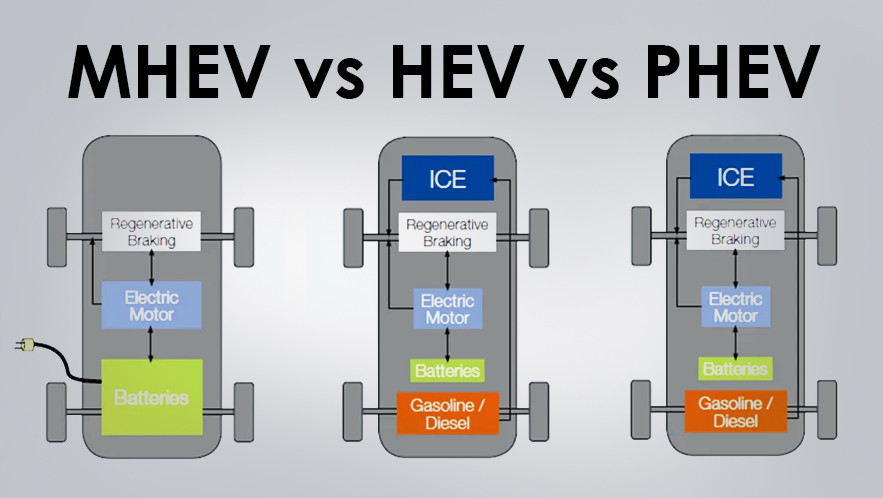
MHEV (Mild Hybrid Electric Vehicle) is usually referred to as a mild hybrid, but the word “hybrid” is somewhat misleading here, because MHEVs are not designed for fully electric driving.
In this configuration, the internal combustion engine remains the undisputed center of the system. An additional electric motor (usually a 48V starter-generator) acts as an assistant: it helps to start from a standstill, smooths out pauses when shifting gears, and partially compensates for the load during acceleration. It is not capable of powering the car on its own.
The key idea behind MHEV is not to replace the internal combustion engine, but to make it more efficient by reducing fuel consumption and emissions and improving smoothness, because the Start Stop system works almost imperceptibly to the driver.
Energy is stored in a compact battery that is charged through energy recovery. When the car begins to brake, the system converts part of the kinetic energy into electrical energy and stores it. Everything happens automatically and does not require the driver's involvement.
It is important to understand the limitations of MHEV:
- there is no electric mode as such;
- there is no charging from an external source or the mains;
- the system works exclusively as an auxiliary technology, not as an alternative to a conventional car.
This is why MHEVs are often chosen by those who are not ready to change their habits but want slightly lower costs and modern environmental solutions.
HEV – a classic hybrid for the city
HEV (Hybrid Electric Vehicle) is a full-fledged hybrid electric car in which two energy sources work as a single unit. It was these models that made hybrids popular around the world.
Unlike MHEV, here the electric motor can not only assist the internal combustion engine, but also temporarily replace it. This is especially evident in city traffic: when driving slowly, in traffic jams, or when maneuvering in a parking lot, the car can start and cover short distances using only electric power.
The system constantly analyzes driving conditions and decides what is more economical at any given moment: to consume fuel or to use stored electrical energy. The driver does not need to switch anything manually—everything happens in the background.
The battery in a HEV is larger than in a mild hybrid, but it is still not designed to be plugged into a power outlet. The car does not require an external power source or charging station, as it is charged while driving and during regeneration.
This is where the logical comparison between PHEV and HEV comes in. The latter is easier to use, does not depend on infrastructure, but has limited electrical potential. This makes it ideal for the city, but less effective on long routes without stops.
PHEV – a compromise hybrid that can be charged from a power outlet
PHEV (Plug-in Hybrid Electric Vehicle) is the most complex and flexible type of hybrid. It is often referred to as a “chargeable hybrid,” and this name most accurately describes the essence of the system.
The main difference between a PHEV is its much larger battery, which can be charged from an external source. This is where the concept of plug-in comes in, i.e., physically connecting to the grid at home, at work, or at a charging station.
In everyday life, a PHEV can operate as a fully electric vehicle. The battery capacity is usually sufficient to cover daily city routes without using fuel. This electric range makes PHEVs particularly attractive for those who drive short distances.
When the charge runs out, the car automatically switches to classic hybrid mode. The engine starts working together with the electrical system, and the journey can continue without any range restrictions. It is this versatility that makes PHEVs a compromise between hybrids and BEVs.
At the same time, it is important to remember that the efficiency of a PHEV directly depends on the discipline of the owner. Without regular charging from an external power source, it loses most of its advantages and turns into a heavy HEV.
Comparison of hybrids: table and key differences
At this stage, it is important not just to look at the dry figures, but to understand the logic behind each type of drive and how hybrid systems differ not on paper, but in real life.
| Parameter | MHEV | HEV | PHEV |
| Fully electric driving | No | Short term | Yes |
| Mains charging | No | No | Yes |
| Battery size | Minimum | Average | Large |
| Electric range | 0 km | 1–3 km | 30–80 km |
| Orientation | Internal combustion engine support | City | Versatility |
| Fuel consumption and emissions | Slightly lower | Significantly lower | Minimal when charging |
Explanation of the table:
- Electric mode. MHEV cannot power the car on its own. HEV can run briefly without fuel, but only under favorable conditions. PHEV allows you to plan your trips so that most of your daily routes are covered in electric mode.
- Infrastructure dependence. HEV and MHEV are completely autonomous and do not require an external power source. PHEV, on the other hand, is only most effective when there is access to charging facilities.
- Costs and operation. The more complex the system, the more components require attention. At the same time, it is the PHEV that provides the best balance between economy and versatility when operated correctly. On the other hand, HEV technology has been around for quite some time, so repair and maintenance of such hybrids will be less problematic.
It is important to dispel a popular myth: “all hybrids are the same.” In fact, the difference between MHEV and PHEV is greater than between a classic car and a first-generation hybrid. In addition, typical defects in different hybrids also vary greatly.
Which type to choose: practical recommendations
Choosing a hybrid car is not a matter of fashion, but of how you use your vehicle. The same car can be ideal for one person and completely unsuitable for another.
- Daily city driving. If most of your routes are in city traffic with frequent stops and low speeds, a HEV makes the most sense. It does not need to be charged, but it makes effective use of recuperation.
- Short trips with the possibility of recharging. PHEVs reveal their potential if there is access to a power outlet at home or at work. In this case, fuel costs can be minimal.
- Long routes and highways. For drivers who frequently travel between cities, MHEVs may be a rational choice: they do not complicate the design of the car, but provide tangible savings.
- Limited budget. MHEVs are usually cheaper to buy and maintain. This is a compromise for those who want modern solutions without making drastic changes to their lifestyle.
- Skepticism towards new technologies. If a driver is not ready to depend on an external power source, an HEV will be psychologically easier and more understandable.
Who might not be suited to a hybrid
A hybrid is not a universal solution. If you rarely drive in the city, do not have access to charging infrastructure, and expect maximum simplicity, classic cars are still the way to go.
Why a hybrid is not an electric vehicle
Despite the similarity in terms, hybrid cars are not a full-fledged alternative to BEVs. Fully electric vehicles run exclusively on batteries and require constant access to infrastructure. Hybrids are designed as a compromise, not a replacement.
This is why hybrids do not use fuel cells and do not rely on a single concept of movement. They can move and drive the wheels in different ways depending on the situation.
Conclusion
Hybrid systems are not a temporary trend, but a logical stage in the development of automobiles. Understanding what the abbreviations MHEV, HEV, and PHEV mean will help you avoid disappointment after your purchase.
In 2026, hybrids remain relevant thanks to their flexibility, adaptability, and real savings. The main thing is to choose a system that suits your lifestyle, and it is advisable to entrust the technical side of operation and diagnostics to STS specialists in Warsaw.