

Types of car suspensions: advantages and disadvantages
The suspension is one of the key parts of any vehicle's design, as it connects the wheels to the body and is responsible for stability, handling, and ride comfort. It is through this system that loads from the road are transferred to the car, and shocks and vibrations must be minimized as much as possible. Different types of suspension appeared long before the mass production of cars: the basic principles were already used in horse-drawn carriages, coaches, and the first flatbed trucks.
With the development of speed and the increasing complexity of designs, there was a need not only to withstand loads, but also to ensure stability, predictable road behavior, and traffic safety. That is why the types of car suspensions have evolved from simple mechanical schemes to complex multi-component solutions with electronic control.
What types of suspensions are there in cars?
A modern car suspension is a complex system consisting of elastic, guide, and damping elements. It includes levers, springs, shock absorbers, joints, rods, silent blocks, and auxiliary components that work together as a single unit. The main task of such a system is to dampen vibrations from the road, maintain constant wheel contact with the road surface, and prevent excessive movement of the body relative to the axle.
In automotive engineering practice, all types of suspension systems are conventionally divided into three basic groups: dependent, semi-dependent, and independent.
Dependent car suspension
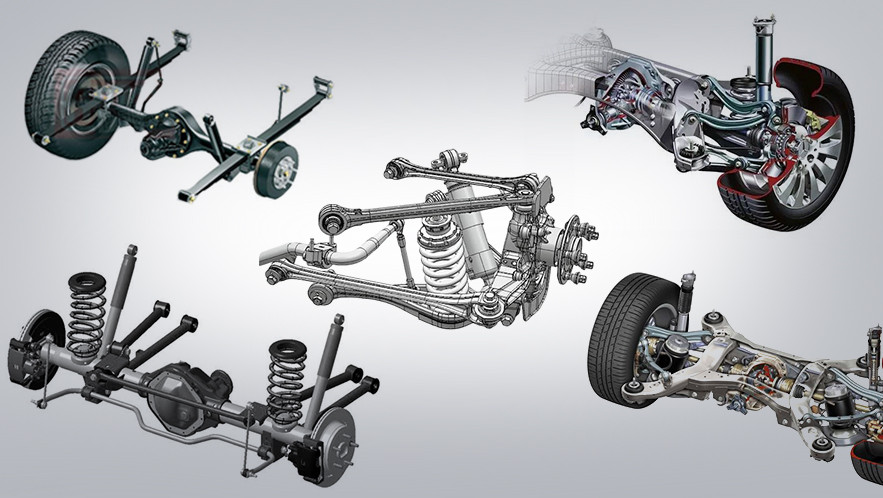
The oldest type, this suspension was used long before the invention of the car. A dependent design involves a rigid mechanical connection between the wheels of the same axle. When one wheel hits a bump, the other is forced to repeat this movement, even if the road surface beneath it is flat. This solution is technically simple and extremely durable.
The most common subtypes are:
- Leaf spring — a classic option in which the leaf spring acts as both a spring element and a guide. Often used on the rear axle of commercial models.
- Spring with a rigid beam — a more modern version, where the load is absorbed by a separate spring, and the beam acts as a wheel connector.
Such solutions are well suited for conditions where load capacity and durability are important. That is why the dependent suspension is still used on freight transport and some off-road vehicles. Its main disadvantage is limited ride comfort and the transmission of vibrations to the body.
Independent suspension
Used in more modern cars, it was invented to improve ride comfort and handling. In an independent suspension, each wheel has its own trajectory and is not directly connected to the other wheel on the same axle. This has a positive effect on handling, stability in turns, and constant traction with the road surface.
Common subtypes of independent suspension:
- MacPherson — one of the most common designs, in which the shock absorber and spring element are combined into a single strut. Often used as a front option.
- Multi-link suspension — a complex design consisting of several levers, allowing precise control of the wheel position in space.
- Pneumatic type — instead of traditional springs, pneumatic cylinders are used, the pressure in which can be changed depending on driving conditions.
Independent suspension systems provide a high level of comfort and precise interaction with the steering mechanism, but have a more complex structure and higher technical requirements.
Semi-independent suspension
The semi-independent design combines elements of the two previous types. The wheels are not rigidly connected, but there is a flexible connection between them that affects their interaction. The most typical example is a torsion beam.
In this design, the cross member can twist, compensating for the difference in wheel travel. This allows the impact of road irregularities to be partially isolated and acceptable stability to be maintained.
The main features of semi-independent suspension are:
- compactness and low weight;
- optimal for the rear axle of passenger car models;
- well suited for urban driving conditions.
Due to the simplicity of its design, maintenance of such a system is relatively affordable, although it is inferior to independent solutions in terms of response accuracy.
Modern active and adaptive suspensions
Modern active solutions, which combine mechanical parts with electronic control, constitute a separate category. Their distinctive feature is that their operating parameters change in real time.
Active suspension uses sensors to measure speed, wheel position, and body acceleration. Based on this data, the electronic control unit changes the stiffness of the shock absorbers or the pressure in the pneumatic elements. This allows you to:
- maintain stability at high speeds;
- improve handling in corners;
- reduce the load on the axles when driving over uneven surfaces.
Adaptive systems are particularly common in the business and premium car segments, where a combination of comfort and safety is important.
Comparison of suspension types
| Suspension type | Advantages | Disadvantages | Repair cost |
| Dependent | Strength, simplicity, high durability | Less comfort, wheels affect each other | Low |
| Semi-dependent | Compactness, balance of characteristics | Limited controllability in difficult conditions | Average |
| Independent | Stability, precise grip, comfort | Complex design, more parts | Higher |
| Active | Adaptation to conditions, maximum comfort | High complexity, expensive diagnostics | High |
The choice of the optimal solution depends on the class of the vehicle, the type of operation, and the expected level of comfort.
The role of the steering damper in the suspension
Special attention should be paid to the steering damper — an auxiliary element that reduces vibrations and shocks transmitted from the wheels to the steering mechanism. It is especially useful on cars with rigid or reinforced suspension, as well as after chassis repairs, as it increases handling stability and driving comfort.
Signs of suspension wear requiring repair
Regardless of the type of suspension used, its components wear out over time. Even a minor malfunction can negatively affect handling and driving safety.
The main symptoms are:
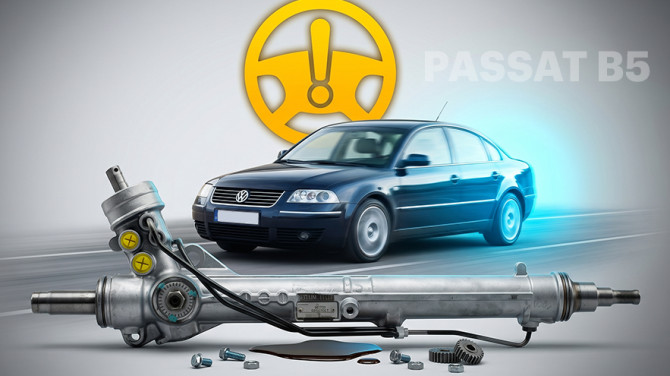
- extraneous noises (primarily from the steering rack) or play during movement;
- decreased steering precision and unstable vehicle behavior;
- uneven tire wear;
- fluid leakage from shock absorbers and loss of ability to dampen vibrations;
- damage or wear to components such as the stabilizer bar or tie rod.
Proper diagnosis and timely repair directly affect handling, road grip, and overall traffic safety, allowing you to avoid overloading the steering system and maintain driving stability.
For the STS auto repair shop in Warsaw, working with suspensions is a daily specialization. The service specialists have experience in servicing various designs: from classic dependent schemes to modern active solutions. Professional diagnostics, understanding of the features of each system, and an attentive approach to details allow STS to ensure the reliability of the suspension and the stability of the car in real operating conditions.