

Why Do Cars Need 48 Volts? The Main Reasons for Switching to MHEV Mild Hybrids
According to analysts at JATO Dynamics, the share of vehicles equipped with mild hybrid technology in the European market has rapidly surpassed the 25% mark and continues to grow steadily. Whereas electrification used to be the exclusive domain of luxury brands, today the 48-volt system has become the standard for the mass market—from city hatchbacks to large SUVs.
Why have global automakers orchestrated such a quiet yet massive technical revolution? For engineers, this turned out to be the only viable way to simultaneously meet three stringent market demands: significantly reduce fuel consumption, comply with strict environmental limits, and enhance vehicle performance without increasing engine displacement.
But many car owners and service center technicians still have questions about mild hybrids: what are they really—just another marketing gimmick or a genuine necessity? Let’s break down how this architecture works, where it hides its hidden savings, and why auto service centers should start preparing to service them now.
Mild hybrid—what is it really, and how does it differ from a car with an internal combustion engine and a full hybrid (HEV)?
There is still a persistent misconception in the automotive world: namely, that a 48-volt mild hybrid is just a regular car with a slightly larger battery and a more powerful starter. This is categorically not true. MHEV represents a fundamentally different system of interaction between the electric and mechanical components of a car. We’ve previously explained the 48V architecture and how it differs from other types of hybrids on our blog.
It is important to understand: a mild hybrid is not a full-fledged hybrid (HEV—Hybrid Electric Vehicle) in the classical sense, such as the Toyota Prius. Unlike full hybrids or plug-in hybrids (PHEVs), a car with an MHEV system cannot run solely on electric power. There is no electric drive motor of a certain power capable of moving the car when the internal combustion engine is turned off.
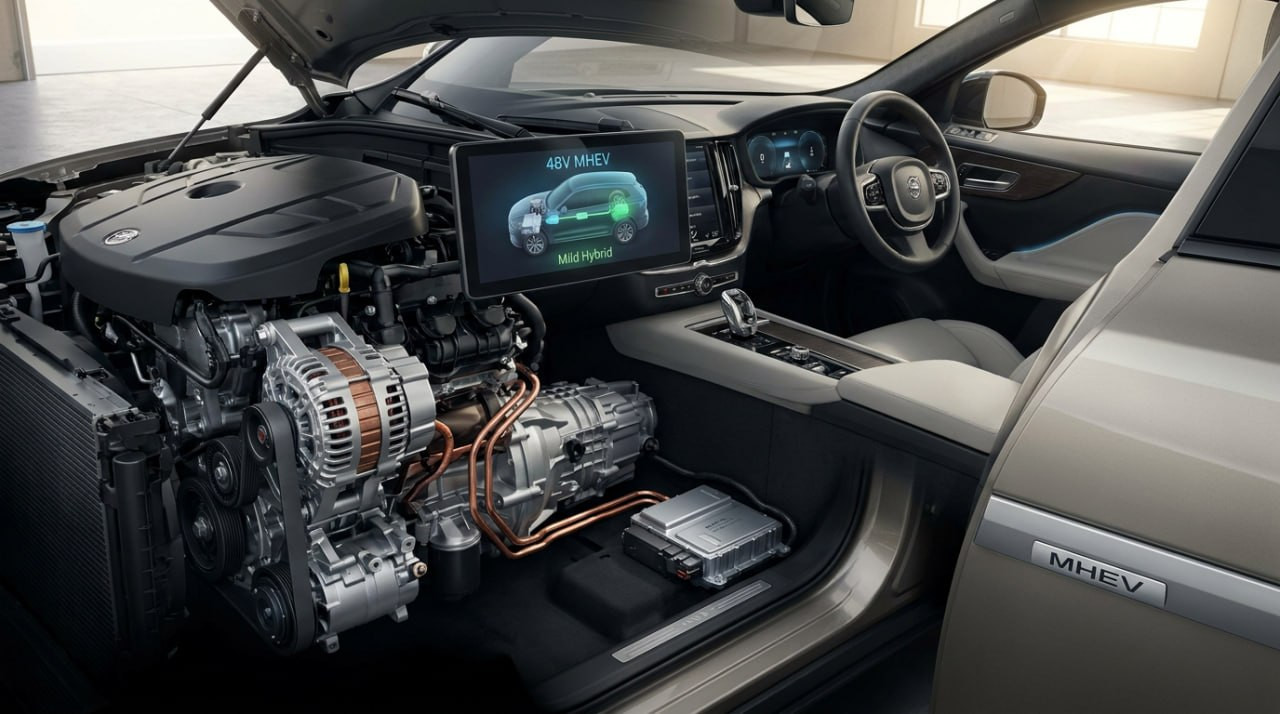
The system is based on a compact 48-volt unit that acts as an assistant to the main gasoline or diesel engine. It takes over during critical operating modes where the internal combustion engine’s efficiency is minimal and provides the following functions:
- Assistance during start-up and acceleration: the electric motor adds torque to the crankshaft, compensating for the lack of low-end torque during intense acceleration.
- Energy recovery during braking: capturing kinetic energy that was previously irretrievably dissipated into the air as heat through the brake pads and rotors.
The key technical difference from a traditional 12-volt system lies in performance. A standard 12V automotive AC generator is capable of producing and recovering no more than 1–1.5 kW of energy. A 48-volt starter-generator recovers up to 12–15 kW of energy during deceleration. This significant amount of energy is stored in a separate lithium-ion battery with a capacity of approximately 0.5–1 kWh.
Depending on the design, automakers use two main types of 48V units:
- BSG (Belt Starter Generator) / RSG: Belt-driven starter-generator. It is installed in place of the standard generator and connected to the crankshaft via a reinforced V-belt. This is the simplest, cheapest to manufacture, and most common solution, which is easy to integrate into the architecture of existing engines without modifying the cylinder block.
- ISG (Integrated Starter Generator) / ISG: Integrated starter generator. This electric motor is mounted directly between the engine and the transmission (effectively replacing the flywheel). This configuration is significantly more expensive but much more efficient: it delivers more torque, is free from the limitations of a belt drive, and ensures a completely silent, instantaneous start of the internal combustion engine.
At the same time, the classic 12-volt lead-acid battery remains in place. Two electrical systems operate in parallel in the vehicle: a low-voltage 12V system (responsible for the in-car multimedia, locks, power windows, and interior lighting) and the vehicle’s 48-volt power system, connected via a special bidirectional DC/DC converter.
Reason 1. Real fuel savings: how three engineering mechanisms work
When automakers tout fuel efficiency, skeptics immediately bring up WLTP lab tests, which are far removed from real-world driving. However, the implementation of 48V architecture delivers tangible, real-world fuel savings for hybrids in the range of 10–15% in combined and city driving cycles. Let’s break down the three distinct mechanisms that achieve this result.
1. Effective energy recovery during vehicle braking
In city driving, the driver constantly alternates between accelerating and braking at traffic lights, crosswalks, and in traffic jams. Every time the accelerator pedal is released or the brake is pressed, the vehicle’s braking energy recovery switches the 48-volt starter-generator into generation mode. Instead of relying on brake resistance, the car decelerates using the electric motor’s magnetic field. The free electricity generated is instantly sent to the lithium-ion battery to power the car’s electrical systems or provide additional traction during acceleration.
2. Ultra-fast and comfortable next-generation start-stop
Conventional 12-volt "Start-Stop" systems annoy drivers: the engine stalls at traffic lights, and its subsequent restart is accompanied by noticeable vibration, a starter "growl," and a delay of around 700–900 milliseconds. Drivers often simply turn off this feature with a button on the dashboard, negating the entire point of fuel economy.
The 48-volt mild hybrid system radically changes this process. A powerful starter-generator (especially the ISG type) spins the crankshaft up to operating speed in just 300–400 milliseconds—faster than the driver can move their foot from the brake pedal to the gas pedal. The start-up is completely silent, with no body vibrations. Moreover, the electronics are able to shut off the internal combustion engine in advance—not when the car has already stopped, but while coasting at speeds below 20–22 km/h or during steady coasting on the highway (Sailing/Coasting mode). As soon as you touch the accelerator, the internal combustion engine instantly and imperceptibly kicks in.
3. Freeing the engine from mechanical “parasites”
In a conventional car, the engine is forced to expend part of its usable power to drive auxiliary equipment via belt drives. The air conditioning compressor, the cooling system pump, and the power steering pump—all these components consume precious horsepower and fuel even when their maximum performance is not required.
The transition to a 48-volt system allowed engineers to make these components self-sufficient and switch them to electric power. The 48-volt electric air conditioning compressor or cooling pump consumes exactly as much energy as is needed at that moment, regardless of the engine’s RPM. This significantly reduces the load on the engine and saves fuel.
Real-world case study: Independent tests of the popular Volkswagen Golf 1.5 eTSI (equipped with a 48V MHEV system) compared to a similar all-gasoline Golf 1.5 TSI showed a consistent reduction in fuel consumption in urban conditions of 0.4–0.6 liters per 100 km. In terms of daily use and commercial fleets, this translates to massive savings.
Reason 2. Environmental requirements and regulatory pressure: why automakers are rushing
To fully understand why a car needs 48 volts, you need to look at the situation through the eyes of top managers at automotive brands. The mass adoption of MHEVs is not so much an altruistic concern for the environment as it is a pragmatic, carefully calculated move to protect the business from significant financial penalties imposed by international regulators.
Strict environmental standards in effect worldwide are putting automakers in a bind. For example, European Union legislation has required automakers to reduce the average carbon dioxide (CO2) emissions across their entire model range to strict limits:
- By 2021, this figure was to be no more than 95 g CO2/km.
- By 2025, the bar has been lowered even further—to 81 g CO2/km.
- Even more stringent comprehensive Euro 7 CO2 emission standards are expected, which will assess exhaust toxicity under any operating conditions, even the most extreme, and during cold starts.
The cost of a mistake runs into the billions. Already, for every single gram exceeding the established CO2 limit on every car sold, the automaker is required to pay a fine of 95 euros. When a company sells a million cars a year, exceeding the standard by just 3–5 grams means an automatic charge of hundreds of millions of euros in net losses.
Why, then, not switch the entire model range to pure electric vehicles (BEVs) completely and immediately? Because the global industry and end consumers are not yet technologically or economically ready for this:
- Mass charging infrastructure in many regions is still in its infancy.
- The cost of large traction batteries remains high, making electric cars unaffordable for the middle class.
- Factories cannot instantly reconfigure assembly lines without risking a production shutdown.
48V mild hybrid technology has become the ideal compromise business solution. Integrating a mild hybrid reduces CO2 emissions by 10–20 grams per kilometer, allowing internal combustion engines to remain confidently within legal limits. At the same time, the cost of implementing a 48-volt system for a factory is relatively low—it is significantly cheaper than designing a full-fledged PHEV hybrid with a massive battery and external charging. This has allowed manufacturers to keep classic internal combustion engines on the assembly line, protecting them from regulatory penalties without a drastic price hike for the end consumer.
Reason 3. More power from a smaller engine
It is a mistake to believe that environmental concerns and fuel economy have stifled the driving character of modern cars. On the contrary, the vehicle’s 48-volt system has opened up new possibilities for engineers to improve engine performance and responsiveness, smoothing out the major design challenges of modern engine manufacturing.
In the past, in an effort to reduce fuel consumption, engineers took the radical approach of reducing the displacement of the cylinders while simultaneously installing a high-performance turbocharger. Such engines look great on paper, but in reality, they have a significant drawback—the so-called “turbo lag.” At low RPMs (up to 1,500–1,800 RPM), there isn’t enough exhaust gas to spin the turbine wheel, so when you press the gas pedal hard, the car initially “hesitates,” and only then does a sharp surge follow.
Electrification of the vehicle’s electrical system solves this problem in two ways:
1. Instant electric boost during overtaking
When pulling away from a stop or accelerating sharply to pass on the highway, the 48-volt starter-generator (BSG/ISG) instantly switches to electric motor mode. It adds 10 to 20 Nm of torque directly to the crankshaft precisely in the RPM range (1,000–2,500 RPM) where the turbocharger has not yet reached operating pressure. Electric traction fills the gap, ensuring a linear, predictable, and, most importantly, instantaneous response of the vehicle to the accelerator pedal.
2. High-performance 48V electric compressor
In premium and sports models (e.g., Audi SQ7, Mercedes-Benz C300de), the powertrain’s electrical system powers a unique component—a 48V electric supercharger. This is an additional supercharger whose impeller is spun up by a powerful, compact electric motor in a fraction of a second (less than 250 milliseconds), regardless of the current exhaust gas flow. The electric compressor immediately creates the necessary boost pressure in the cylinders, completely eliminating the concept of "turbo lag" as a phenomenon.
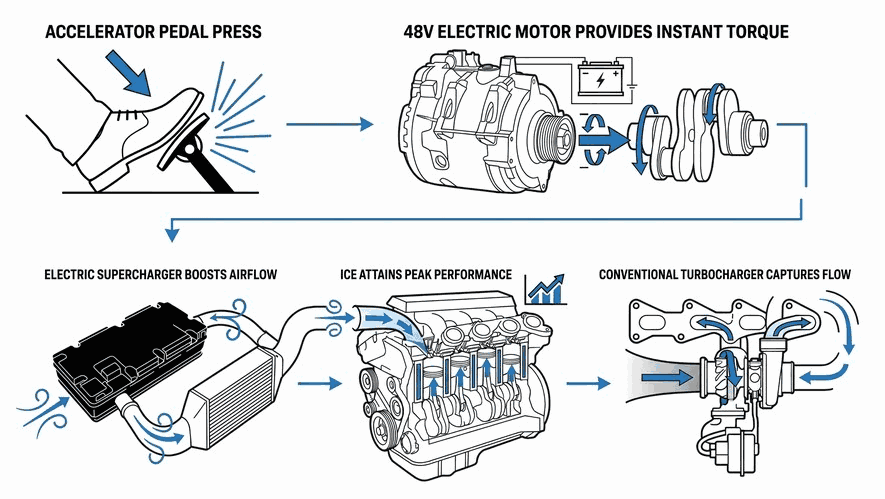
Thanks to this, automakers have been able to extract high power output from engines of modest displacement, ensuring the driver smooth, confident, and safe acceleration in any driving situation.
What’s changing in steering systems
Beyond all of the above, the introduction of 48-volt architecture has brought fundamental changes to the design and operating principles of steering systems.
First, the increased voltage has finally sounded the death knell for classic belt-driven power steering (PS) systems connected to the engine pulley. They have been irrevocably replaced by electric power steering (EPS) systems and electro-hydraulic power steering (EHPS) units.
Second, in the segment of heavy crossovers, full-size SUVs, pickups, and premium sedans, the standard power of a 12-volt system is no longer sufficient to effectively power electric motors. To turn the wheels of a heavy off-road vehicle or a large frame-based car on the spot, high currents are required. In a 12-volt system, this leads to significant heating of the wiring, the need for thick, heavy power cables, and, consequently, energy losses.
Using a 48V electric steering drive solves several important engineering challenges:
- Reduced current and weight: According to Ohm’s law, when the voltage is increased fourfold (from 12V to 48V), four times less current is required to deliver the same power. This allowed us to reduce the cross-section of the power wires, make the servo control board more compact, and significantly reduce the overall weight of the steering rack.
- Increased power and precision: The 48-volt EPS operates much faster and generates significantly more torque on the steering shaft. This is critical for integrating autopilot systems, lane-keeping functions, automatic parking, and active maneuvering in emergency situations.
- Compatibility with complex chassis: The 48-volt power supply enables simultaneous powering not only of the power steering unit but also of active roll stabilizers and rear-axle steering systems, transforming the chassis into a single high-speed digital system.
Diagnostics, maintenance, and repair of steering racks with EPS require in-depth knowledge of the architecture of high-speed automotive CAN buses and FlexRay, specialized licensed scanners and oscilloscopes, as well as an understanding of the synchronization algorithms between the steering control unit and the main 48-volt hybrid powertrain controller.
What this means for auto repair shops: The B2B perspective on the service market
Independent repair shops and auto service centers should not panic or view the emergence of MHEV technology as a threat to their business. This is a natural evolution of the market, and whoever masters the new standards first will gain a significant competitive advantage. It is reasonable to assume that in just 3–5 years, a significant portion of the vehicles coming in for post-warranty service will be 48-volt mild hybrids.
What exactly is changing in the work of service advisors and mechanics, and what remains the same?
New:
- High-power lithium-ion batteries (48V): They require special monitoring of temperature parameters, cell balancing, and specific safety procedures.
- BSG units: Belt-driven starter-generators place increased stress on the drive belt and tension rollers due to constantly changing force vectors (sometimes the engine drives the generator, and sometimes the generator drives the engine). The belts here are reinforced, and their replacement schedule must be strictly followed.
- Complex liquid cooling systems: Since DC/DC converter units and battery management systems (BMS) generate significant heat, they are often connected to the vehicle’s general or dedicated cooling circuit. Service technicians must be able to service these systems without venting the circuits.
Read in our company’s portfolio about how STS auto shop specialists successfully perform repairs on MHEVs, as well as vehicles with other hybrid systems.
What remains:
Conventional internal combustion engines, suspension components, the braking system, most transmission components, and even the mechanical steering system—all of these are serviced and repaired according to standard, well-established technical procedures.
Therefore, service center managers do not need to urgently invest tens of thousands of dollars in purchasing radically new, heavy equipment. However, it is critically important to invest in staff training. Auto electricians and diagnosticians must clearly understand the logic of interaction between the 12-volt and 48-volt systems, be able to safely de-energize the vehicle’s power circuit for repair work, and correctly interpret specific error codes from the hybrid drive control systems.
Comparison of Automotive On-Board Network Technologies
Let’s look at a comparative table that reflects the current structure of the automotive market and the position of mild hybrid technology in the market.
| Characteristics | Conventional 12V vehicle | 48V Mild Hybrid | Full Hybrid (HEV / PHEV) |
| Vehicle electrical system voltage | 12V only | Combined: 12V + 48V | Combined: 12V + 100V to 300V+ |
| Energy recovery power | None (conventional battery charging ~1 kW) | High (up to 12–15 kW) | Very high (up to 50+ kW) |
| Electric-only driving | No | No (only short-term internal combustion engine assistance) | Yes (1 to 50–100+ km for plug-ins) |
| Real-world fuel economy (WLTP) | Basic engineering level | Up to 10–15% in city driving | Up to 35–40% thanks to a high-capacity battery |
| Estimated system cost for the plant | Base vehicle cost | Moderate price increase (+$500–1,500) | Significant price increase (+$3,000–8,000) |
| Complexity of repair and diagnostics | Standard, well-known to mechanics | Moderately increased (requires knowledge of CAN/48V) | High (requires high-voltage certification) |
| Global market share (2024–2026 estimate) | ~60% of the market (gradually declining) | ~25% of the market (fastest growth) | ~15% of the market (stable niche) |
As we can see, the 48V mild hybrid is a rational and balanced compromise between implementation costs for the automaker and real fuel and technological benefits for the mass consumer. It does not require the car owner to radically change their driving habits (such as searching for charging stations), yet it provides all the key benefits of modern electrification.
Is your service station ready to service the new generation of cars?
The technological trend is clear: vehicles with 48V architecture have already become an everyday reality on the roads of Poland and the EU as a whole, and their numbers will grow rapidly every year. It is important for MHEV owners and managers of independent auto service centers to have a reliable technical partner capable of providing professional support in the field of complex powertrain solutions.
STS closely monitors the evolution of automotive technology. Our specialists possess the necessary expertise, high-precision diagnostic equipment, and specialized test benches for inspecting, repairing, and servicing modern 48V electric power steering racks, electrohydraulic pumps, and related components of complex onboard systems.
Need professional advice on diagnosing steering systems in mild hybrids, selecting genuine parts, or repairing complex electronic assemblies? Contact the experts at STS.Parts—we’ll help your vehicle or your business stay one step ahead of technological progress!